
What Is a Percolator Bong? Perc Types Explained
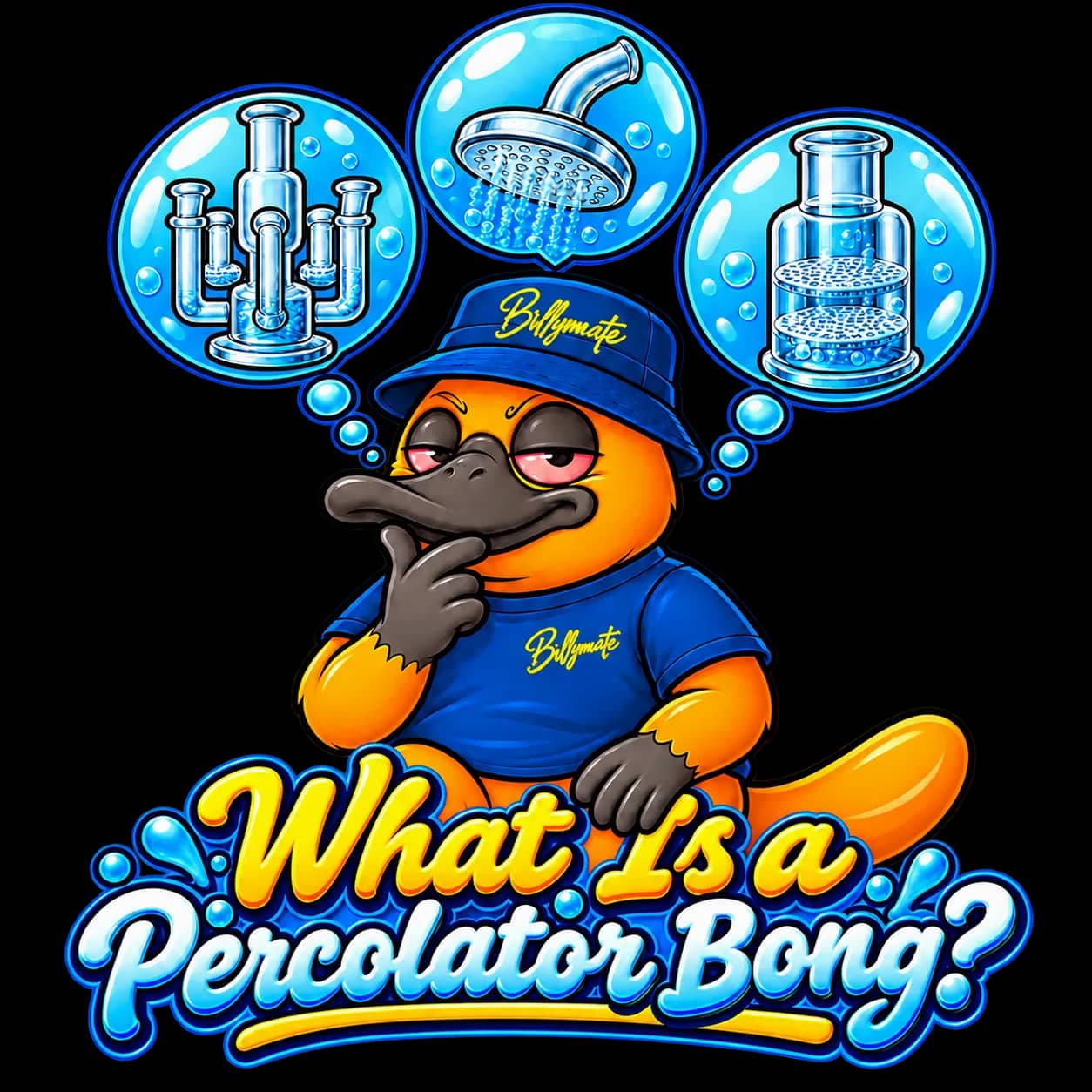
Learn what a percolator bong is, how bong percs work and the differences between tree, showerhead, honeycomb, inline and other popular percolator designs.
If you have ever looked inside a more advanced glass bong and seen discs, arms, tubes or unusual glass structures, you were probably looking at a percolator. Usually shortened to perc, a percolator is an internal glass component that divides airflow into multiple smaller streams as it passes through water.
Some bongs have one perc. Others have several. And some simple glass bongs do not have a separate percolator at all. This Billy Mate guide explains what a bong percolator is, how it works and the main types of percs you are likely to encounter.
A percolator bong is a bong that contains one or more internal glass structures designed to create additional bubbling through water. The percolator usually contains small holes, slits, arms, discs, tubes and multiple openings.
As airflow moves through the perc, it is divided into multiple paths. This creates many individual bubbles rather than one large stream.
The easiest way to understand a percolator is to think of water flowing through a showerhead. One large stream enters, and many smaller streams leave. A bong percolator works on a similar principle.
Air enters the percolator through a tube or chamber. It then exits through multiple slits, holes, arms or openings. Those outlets create multiple bubbles in the surrounding water. Different perc designs achieve this in different ways.
No. A basic bong may only have a mouthpiece, chamber, water, downstem and cone piece. If the downstem itself has diffuser slits, it already creates multiple bubbles without requiring a separate perc chamber. A percolator bong usually adds another internal glass structure beyond the basic downstem.
These are closely related but they are not the same thing.
Diffused Downstem
A diffused downstem has multiple openings near the bottom of the stem. It introduces airflow into the main water chamber.
Percolator
A percolator is an additional internal glass structure positioned inside the bong. It may sit above the main chamber, inside the main chamber, between two chambers, or in several stacked sections.
A bong can use both. For example, from the cone piece up:
- Cone piece
- Diffused downstem
- Lower water chamber
- Percolator
- Upper chamber
- Mouthpiece
Glassmakers can divide airflow in many different ways. That has led to a huge variety of percolator styles. Some are designed to be simple and compact. Others prioritise a large number of small openings. Others are chosen because they create a visually impressive glass design.
The main differences between percs are usually the number of openings, the size of openings, the shape, the position in the bong, the water requirement, the airflow resistance and the ease of cleaning.
A tree perc is one of the easiest percolators to recognise. It consists of several small glass arms extending downward from a central section. Each arm contains slits or openings near the bottom. From the side, it resembles the branches of a tree.
How a Tree Perc Works
Air enters the central section and is distributed among the multiple arms. It then exits through the openings at the bottom of each arm. More arms generally mean more individual outlets. You may see 4-arm, 6-arm, 8-arm and larger multi-arm versions.
Advantages
Easy to identify, multiple airflow outlets, visually impressive and common in taller glass bongs.
Things to Consider
Tree percs contain several thin glass arms. That can make them more delicate, more difficult to clean and more prone to residue collecting inside individual arms.
A showerhead perc usually has a central vertical tube leading into a wider lower section. Around that lower section are multiple slits or holes. The shape resembles a showerhead, which is where the name comes from.
How It Works
Air moves down through the central tube and exits through the openings around the bottom. This creates bubbles in a circular pattern.
Advantages
Compact design, multiple openings, good use of chamber space, and often easier to construct as one solid glass piece.
Things to Consider
The small openings need to remain clean. Residue around the slits can reduce airflow over time.
A honeycomb perc is usually a flat circular glass disc containing many small holes. It is one of the most recognisable modern perc designs. From above, the pattern can resemble a honeycomb.
How It Works
Air is forced through the many small openings in the disc. This creates a large number of small bubbles across the surface.
Advantages
Very high number of openings, compact vertical profile, clean symmetrical appearance, and works well in straight tube designs.
Things to Consider
Because the holes are small, they can become clogged if residue builds up. Regular cleaning is especially important with honeycomb designs.
An inline perc is usually a horizontal glass tube with multiple slits or holes along its length. It sits horizontally inside the chamber.
How It Works
Air enters one end of the tube and exits through the openings along the side or bottom. Because the openings are spread across the length of the tube, the bubbles are distributed across a wider area of the chamber.
Advantages
Wide distribution of airflow, visually interesting, works well in larger chambers, and can provide many diffuser openings.
Things to Consider
The horizontal tube can create additional internal areas that require careful cleaning.
A matrix perc is a cylindrical glass structure covered with rows of small slits. The openings may extend vertically, horizontally or in a grid-like arrangement.
How It Works
Air enters the central perc and exits through the many surrounding slits. Because the openings cover much of the cylinder, airflow can leave in several directions.
Advantages
Many openings, compact design, strong visual effect, and often used in premium glass pieces.
Things to Consider
The large number of small slits means regular cleaning is important.
A disc perc uses a flat glass disc with openings that airflow must pass through. Honeycomb percs are technically a specialised form of disc perc, but not every disc perc uses the same honeycomb pattern. Some discs may have large holes, small holes, slits or decorative patterns. Disc percs are often found inside straight glass tubes.
A dome perc uses a dome-shaped piece of glass positioned over a central tube. Air travels into the dome and exits through openings around its lower edge. Dome percs were common in many older glass designs. They are generally simple compared with some newer multi-slit perc designs.
Advantages
Simple construction, easy to recognise and compact.
Things to Consider
More modern designs often provide more openings in the same amount of space.
A turbine perc is usually a disc with angled slits. The angle of the openings can create a swirling movement inside the water chamber.
How It Works
Airflow passes through angled slots around the disc. The direction of the slots encourages water and bubbles to move in a circular pattern. This makes turbine percs particularly visually interesting.
Some bongs use spiral or coil-shaped glass structures. These may guide airflow through a longer or more complicated internal path. They are often chosen as much for appearance as for function. Because of their complex shape, they can also be more difficult to clean.
Some bongs contain one percolator. Others contain several. A multi-perc bong might be arranged like this, from the downstem up:
- Diffused downstem
- Lower chamber
- Honeycomb perc
- Second chamber
- Tree perc
- Upper chamber
That can create a very complicated piece of glass.
Not necessarily. Every additional internal restriction can affect airflow. More percs also mean more glass, more weight, more cleaning, more areas where residue can collect, more water levels to manage and more delicate internal components. A simple bong with a good diffused stem may suit some people better than a very complex multi-perc design.
Yes. A large percolator may contain more openings, but it also takes up more chamber space. The size needs to suit the bong. A compact bong may use a small showerhead or disc perc. A tall 35cm bong has more room for large tree percs, multiple chambers, stacked percs and complex internal designs. This is one reason bong size and perc style often go together. Our Bong Sizes Explained guide covers how height affects the room available for internal features.
A percolator needs enough water around its intended openings to operate correctly. The exact amount depends on the design. A multi-chamber bong may require water in more than one section, for example water in the lower chamber plus water in the upper perc chamber.
The goal is not to fill every chamber as high as possible. You want enough water to cover the required openings without causing excessive splash or unnecessary resistance.
Look at where the slits or holes are positioned. The water level should generally cover the intended openings. If part of the perc is sitting completely above the water, some openings may not be used as intended. If the chamber is significantly overfilled, water can travel higher through the bong. Always check the design of the individual piece.
Here is the basic comparison.
| Feature | Regular Bong | Percolator Bong |
|---|---|---|
| Internal design | Simpler | More complex |
| Separate perc | Usually no | Yes |
| Number of chambers | Usually one | One or more |
| Cleaning | Easier | More detailed |
| Weight | Usually lighter | Often heavier |
| Visual complexity | Simple | High |
| Number of internal openings | Fewer | Often many |
Neither is automatically better. It depends on what type of glass piece you prefer.
Generally, simpler designs with larger openings are easier to clean. A complicated tree perc or multi-chamber bong will normally require more attention than a simple showerhead or open downstem. Among common designs, cleaning difficulty often increases when there are many tiny holes, multiple glass arms, narrow internal tubes, several chambers or difficult-to-reach sections. This is worth considering before buying a very elaborate bong.
Perc bongs should be cleaned before residue becomes heavily built up.
Step 1: Remove Detachable Parts
Remove the cone piece and downstem where possible. Clean them separately.
Step 2: Empty All Water
A multi-chamber bong may hold water in several areas. Tilt the piece carefully until each chamber is empty.
Step 3: Add an Appropriate Glass Cleaner
Make sure the solution reaches the internal perc.
Step 4: Rotate the Bong
Move the cleaning solution around the chamber so it reaches perc holes, slits, arms, tubes and chamber walls.
Step 5: Allow Stubborn Build-Up to Loosen
Complex percs may require more contact time than simple tubes.
Step 6: Rinse Thoroughly
Pay particular attention to small openings. Any remaining cleaner or residue should be fully removed.
Percolators contain many small openings. These can become partially blocked by resin, debris, mineral deposits, dirty water or residue left too long between cleaning. Once a hole becomes restricted, airflow may begin favouring the other openings. Regular cleaning helps the perc continue working as designed.
Usually not. Most percolators are permanently built into the bong. Unlike a removable downstem or cone piece, they cannot simply be pulled out and replaced. Professional glass repair may sometimes be possible, but it depends heavily on where the break occurred, access to the damaged section, the value of the bong and the complexity of the glass. For many pieces, replacing the bong may be more practical.
They can be. The outer glass may be just as thick as another bong, but the internal glass structures add additional delicate components. Tree percs are a good example because they contain multiple thin glass arms. This makes careful handling especially important with complex designs.
Do not confuse the number of percolators with glass thickness. A bong might have an elaborate internal perc but relatively thin outer glass. Another bong might have a simple design but thick 7mm borosilicate glass. When comparing products, check both the internal features and the glass thickness. They tell you different things about the bong.
These features can exist together. An ice catcher sits in the neck and supports ice. A percolator sits lower in the bong and creates additional bubbling through water. For example, from top to bottom:
- Mouthpiece
- Ice catcher
- Upper chamber
- Honeycomb perc
- Main chamber
- Diffused downstem
There is no need to choose one or the other.
Beaker describes the shape of the bong. Percolator describes an internal feature. So you can have a beaker bong without a perc, a beaker bong with a perc, a straight bong without a perc, or a straight bong with a perc. These terms are not opposites. Our Beaker Bong vs Straight Bong guide explains the shape differences.
Start with the overall bong rather than choosing purely by perc type. Consider bong height, glass thickness, base diameter, chamber shape, joint size, downstem design, number of percolators and cleaning difficulty. Then look at the perc style. A bong with ten impressive internal features is not automatically more suitable than a clean, simple design.
| Perc Type | Appearance | Main Characteristic |
|---|---|---|
| Tree perc | Multiple arms | Many separate outlets |
| Showerhead | Round lower diffuser | Circular slit pattern |
| Honeycomb | Flat disc with many holes | Large number of small openings |
| Inline | Horizontal tube | Air distributed across chamber |
| Matrix | Cylindrical grid | Openings around cylinder |
| Disc | Flat glass plate | Air passes through disc openings |
| Dome | Dome-shaped chamber | Simple enclosed perc |
| Turbine | Angled disc slits | Creates swirling movement |
Billy's Tip: When comparing percolator bongs, do not count percs and assume the one with the biggest number wins. Look at the complete bong. A good design needs the chamber, water level, airflow, downstem and perc to work together. Also consider cleaning. If you know you prefer something quick and simple to maintain, a bong with several delicate internal chambers may not be the best choice for you.
A percolator is an internal bong component containing multiple small openings that divide airflow into more bubbles as it passes through water. Different designs achieve this using arms, holes, slits, tubes and discs. The most common designs include tree, showerhead, honeycomb, inline and matrix percs. Once you understand those basic shapes, identifying different bong percolators becomes much easier. For a full breakdown of every bong component, see our Bong Parts Explained: Complete Diagram and Guide.
Billy Mate offers glass bongs with a range of internal designs, including simple diffused systems and more advanced percolator configurations. When comparing them, check height, base size, glass thickness, perc type, joint size, downstem configuration, ice catcher and cleaning requirements. Choose the bong as a complete system rather than focusing on a single feature.